


Duolingo and Babbel are two language learning platforms that are pretty similar. Duolingo is completely free, and Babbel starts at $12.95 per month.
The quickest way to describe the differences between Babbel and Duolingo would be…
- Duolingo is best for casual learners who may want to dabble in a few different languages, may struggle with staying motivated, or aren’t willing to spend money.
- Babbel is best for more serious students who are only interested in learning one language, would like clear explanations, and want to learn content that they’ll use in real conversations.
Which is better? Duolingo or Babbel? I definitely would recommend Babbel ahead of Duolingo for most people. However, there are plenty of other language-learning apps worth considering besides these two.
Table of Contents
Babbel vs Duolingo

Pros
- Relatively inexpensive
- Babbel uses conversational language that you’re likely to use in real life.
- Grammar is explained clearly with lots of examples.
- There is a decent variety of exercise types.
- Lessons progress logically.
- The platform features high-quality audio.
- It offers a nice layout and design.
Cons
- You’ll have to pay for each language.
- The voice recognition software can cause frustration because it does not always recognize what you say.
- The repetitive exercises aren’t very unique.
- You’ll need to use other resources alongside Babbel to get conversation practice.
- Not enough focus is given to grammar concepts in the review exercises.
- Not as many features to keep you motivated
See our Super-Detailed Babbel Review

Pros
- Free unless you want to pay for additional features with Duolingo Plus, which isn’t necessary.
- Quick to get started using
- Lots of features that will keep you motivated
- Game-like exercises make language learning feel fun and casual.
- The course’s leaderboard feature encourages competition with other language learners.
Cons
- Doesn’t focus on useful language – lots of nonsensical sentences
- Audio for full sentences sounds unnatural
- Few explanations
- Repetitive exercises
- Lessons aren’t always structured in the most logical order
- Ignores cultural context
- Not enough focus is given to grammar concepts
See our Super-Detailed Duolingo Review
| Babbel | Duolingo | |
|---|---|---|
| Cost | $7 – $14 /mo $299.5 (One-time payment) | Free $12.99 /mo (Paid version) |
| Number of Languages Offered | 14 languages | 42 languages |
| Lesson Length | 10 – 15 min | 5 – 10 mins |
| Style | Professional | Gamified |
| Lesson Structure | More organized structure | Isn’t always structured in a logical order |
| Grammar | Grammar explanations and tips within lessons | Limited grammar instructions |
| Speech Recognition | Yes | Yes |
What it’s like to use Duolingo
Duolingo is a great way to get introduced to learning a new language, and millions of people have done just that.
The fact that it’s completely free to use has opened up language learning to people all over the world, regardless of their economic situation.
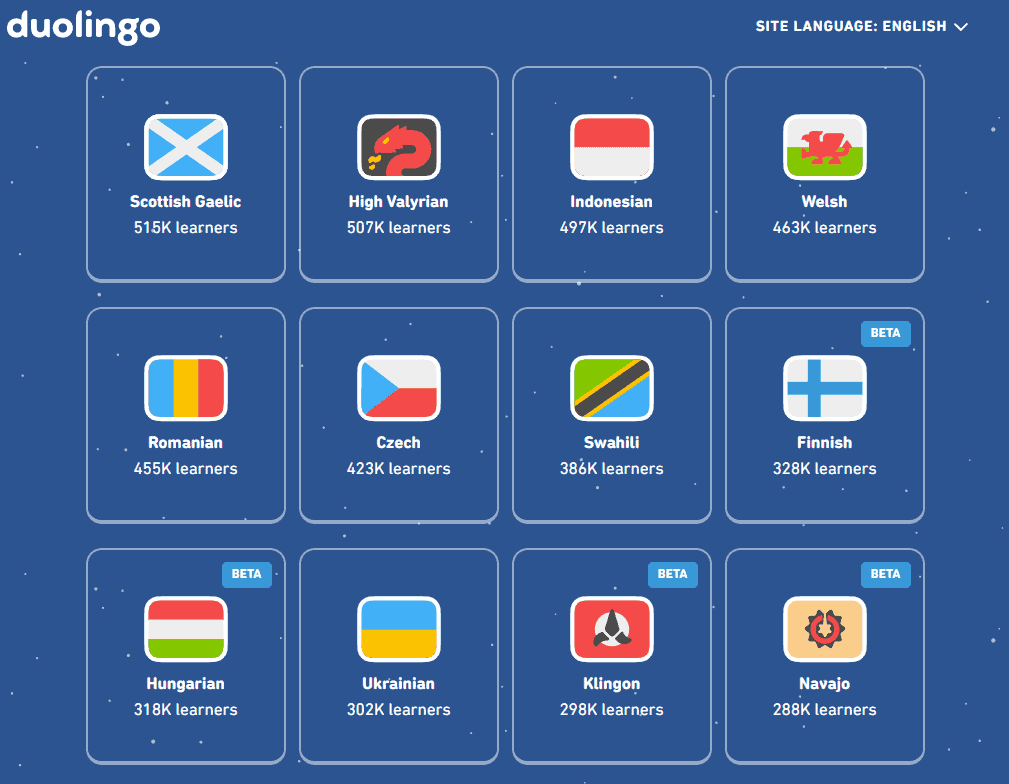
There are currently over 21 million students learning Spanish on Duolingo. With over 30 languages available, the number of users on Duolingo is truly staggering. They’ve even had some fun by adding fantasy languages like High Valyrian and Klingon.
The fact that they’ve opened the doors for so many people to begin learning a new language is really an amazing thing.
Duolingo organizes its content around Skills. These are short mini-units centered around a specific topic, such as family, emotions, routines, or weather.
Because of the way that the Skills are organized, you’ll likely end up learning some fairly obscure vocabulary before more important essentials.

Duolingo also doesn’t have typical lessons like you may expect from a language learning platform. Most of the material is taught simply through repetitive exercises.
Some important words may be first introduced with pictures, but others will show up for the first time in an exercise where you’re supposed to translate a sentence. Luckily, you can click on the words of a sentence to see a translation.

The exercises aren’t particularly hard, and you’ll probably be able to fly through most of them. Most exercises are pretty similar: there’s lots of translating, matching pictures to words, and some listening practice.
One thing that I found to be really frustrating is the audio used in the Duolingo courses. For sentences in some languages, it sounds as if each word was recorded individually as opposed to recording sentences as a whole. Other languages use text-to-speech audio, which means humans never actually said the words you’re listening to.
In either case, sentences can end up sounding extremely unnatural.
An important part of language learning is listening to and mimicking natural language. If you try this with Duolingo, you’re going to sound ridiculous. Speechling can help a lot with this, and I’d suggest checking it out.
Another issue involves the types of sentences that Duolingo teaches. While many of the sentences are normal enough, there are quite a few that you would never use in real life.
You can find some pretty funny ones on this Twitter account.

While it’s completely silly, you are at least learning to construct sentences, and they might even make you smile. That said, some people would prefer using their study time on more practical sentences.
Another issue is that Duolingo completely ignores the culture of the language you’re learning.
While Duolingo does have more than a few issues, it’s hard to complain about something that’s free. They also do something better than any other language learning platform around – even the most expensive ones.
Nobody does as good a job as Duolingo at keeping you motivated and coming back to study each day. Even if it’s just five or ten minutes a day, creating a daily study habit is essential for learning a language.
On Duolingo, you can get achievements, and streaks for studying each day, earn lingots to spend on power-ups, track your study time, and compete for a spot on their leaderboard. They make studying feel more like playing a game.

Duolingo does also offer a premium plan, but most people would be happy with the free version. In their Duolingo Plus plan, you can remove ads, download materials offline, and get a monthly streak repair.
It costs $12.99/mo and falls to $6.99/mo if you subscribe for a year.
Read our full review of Duolingo here
What it’s like to use Babbel
Is Babbel better than Duolingo? While Babbel is one of the most popular online language-learning resources, it has nowhere near as many users as Duolingo.
That shouldn’t come as a surprise considering Babbel costs money to use and Duolingo is completely free.
The good news is that Babbel is one of the most affordable language-learning platforms around. Their subscriptions start at $12.95/mo and fall to $6.95/mo if you purchase an annual plan.
Unfortunately, if you’re the type who likes to dabble in multiple languages, Babbel probably isn’t the best option; their subscriptions only give you access to one language at a time. A tool like Mango Languages could be a good alternative worth considering.
Babbel also doesn’t offer nearly as many languages as Duolingo.
They currently have 14 languages available – German, Spanish, French, Italian, Portuguese, Swedish, Turkish, Dutch, Polish, Indonesian, Russian, Danish, Norwegian, and English.
You’ll notice that many popular Asian languages are missing. For learners of those languages, I’d strongly recommend Lingodeer.

Like Duolingo, the courses are created for beginner to lower-intermediate-level students.
Babbel’s lessons are organized into modules with each module containing various lessons. I found that the content is organized a bit more logically with the more important language being taught earlier on.
The lessons themselves aren’t so different than Duolingo. Neither is the most exciting thing you’ll use to study a language.
Both platforms’ lessons have you do things like matching pictures to words, translations, organizing sentences, and so on.

Duolingo teaches the language by having users complete lots of exercises, offering few explanations. Babbel teaches the language in a much more traditional manner, sort of like you’d expect within a classroom.
This means they’ll take the time to explain grammar and how the language is used much more explicitly instead of just expecting you to pick it up on your own.
I personally prefer this method as it makes it easier for me to achieve a deeper understanding of the language as a whole.

Another major advantage of Babbel compared to Duolingo is its focus on conversational language that you’re likely to use in real life. Babbel doesn’t teach you to make lots of silly sentences that you’ll never use. Instead, you’ll learn to say things that you’ll actually need.
Babbel also doesn’t have the same audio issues that Duolingo does. Whereas Duolingo’s recordings often sound unnatural, Babbel’s audio sounds authentic and natural.

In my experience, the difference in audio quality between the two resources really does make a big difference.
Babbel does have some game-like elements, but they don’t take it as far as Duolingo does. For those who struggle with motivation, this could make it a bit less fun and more challenging to study regularly.
Read our full review of Babbel here
Final Thoughts
So, what’s better Babbel or Duolingo? Overall, Duolingo and Babbel look very similar on the surface. They teach the language in somewhat similar ways, and the exercises look quite a bit alike.
It’s not until you start to dig a bit deeper that you see how these two platforms differ. It’s the content itself that really differentiates these two online language courses.
Duolingo is amazing for a free resource. It makes learning more fun and less intimidating. It also offers a ton of languages and teaches them through lots of entertaining exercises. While there’s plenty of room for improvement, the fact that it makes language learning accessible to people all over the world is incredible.
Babbel is quite good, considering the fact that it’s not very expensive. Unfortunately, a subscription-only gives you access to one language. The teaching method is much more explicit and places more of an emphasis on conversational language than Duolingo, and it’s therefore a bit better for serious learners who want a stronger foundation and a deeper understanding of the language.
Both platforms are a good way to get started learning a language, though I personally prefer Babbel. However, neither Duolingo nor Babbel is great at developing your speaking skills.
Pimsleur does much better with that – though they also have their own weaknesses.
Alternatively, taking regular classes from a tutor on italki is a great way to complement either of these resources. It’s also not that expensive, often less than $10 per hour of private classes.
Because our top recommendations vary so much depending on the language you’re learning, it’d be impossible to list them all here. The links in the table below can help you figure out which resources may be a better choice.
To see all of our self-study guides, favorite programs, online subscriptions, apps, podcasts, and YouTubes for the language you’re learning, look for your language in the table below.
Frequently Asked Questions
Which language app is better, Babbel or Duolingo?
I personally think Babbel is better than Duolingo as it provides more structure, better grammar help, and lessons you can actually use in real life. Duolingo is better for beginners or casual learners who want a fun, free, game-like way to practice. Just note that neither app is strong for developing real speaking skills.
How do Babbel and Duolingo compare?
Babbel and Duolingo both teach languages but in different ways. Babbel offers structured, grammar-focused lessons with real-world dialogues, ideal for serious learners. Duolingo uses a game-like approach with bite-sized exercises, making it better for casual, daily practice. Babbel is a paid app, while Duolingo is free with optional upgrades. Overall, Babbel is better for depth and fluency, while Duolingo is great for beginners and staying consistent.
What is the difference between Babbel and Duolingo?
The main difference between Babbel and Duolingo is in their teaching style and depth. Babbel focuses on structured lessons, grammar explanations, and real-life conversations which is ideal for learners aiming for fluency. Duolingo uses a gamified approach with quick, repetitive exercises, which is better for casual learning and beginners. Babbel is subscription-based, while Duolingo offers a free version with ads.
Is Babbel cheaper than Duolingo?
No, Babbel is not cheaper than Duolingo. Duolingo offers a free version with ads, while Babbel requires a paid subscription. Duolingo also has a premium plan (Super Duolingo), which is more expensive than Babbel’s basic plans. If you’re looking for a free option, Duolingo is more budget-friendly. If you want structured lessons and are willing to pay, Babbel offers good value at a lower cost than Duolingo’s premium tier.
Is Babbel better than Duolingo?
Babbel is better than Duolingo if you want structured lessons, clear grammar explanations, and real-life conversation practice. It’s ideal for serious learners aiming for fluency. Duolingo, on the other hand, is more gamified and beginner-friendly, making it great for casual learning or starting a new language for free. For depth and structure, Babbel is often the better choice.
Is Babbel or Duolingo better for learning Spanish?
I tend to opt for Duolingo because it’s free (mostly). Both apps follow a similar method. They teach you basic grammar rules and vocabulary through translation exercises and then quiz you on what you know. Neither is my first pick for Spanish learning due to the fact that both Babbel and Duolingo follow a translation-first approach. It’s also important to note that these two apps do little to prepare you for Spanish speaking.
Thanks for the useful post, I´m actually using Duolingo mainly because it´s free. As for the pros and cons, I wouldn´t say that being repetitive is a con, lot of people learn by repetition. In fact there´s a japanese teaching method called Kumon that is based in repetition, it can be tedious but I can assure it´s effective, specially with the basics.